Our brands leave a legacy. And they do not leave it to chance.
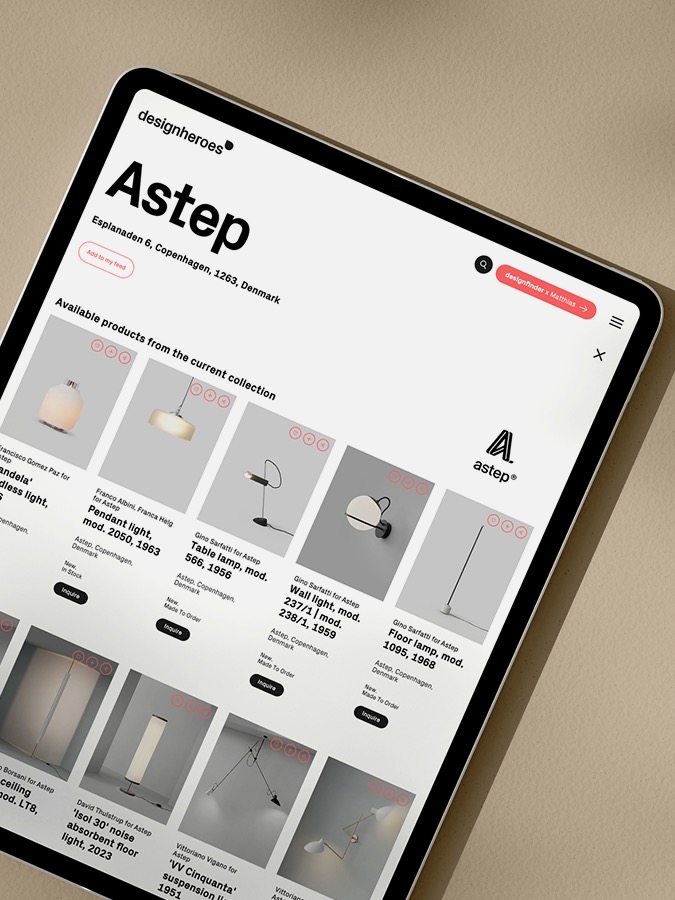
What decides it is not age. It is who you work with, and whether anybody is writing it down. Designheroes is where that record lives: your current collection alongside the design classics it will be measured against, and the history behind it if you have one.

Where you appear is a judgement about your brand. Most brands never make it on purpose.
Most places a brand can appear are listings: a grid of products next to a grid of competitors, judged on price and lead time. Designheroes is the other thing: a curated reference where your work sits among vetted originals from galleries, auction houses, foundations and museums.

Every Brand Partner, Artisan, Gallery, Auction House, Foundation and Museum is reviewed by Designstandard AG before being listed. No replicas. No “inspired by”. No lookalike sitting one row below your original, quietly making the case that the difference does not matter.
For a brand whose products get copied, which is most brands worth copying, that rule is the product. A legacy anyone can counterfeit is not a legacy.
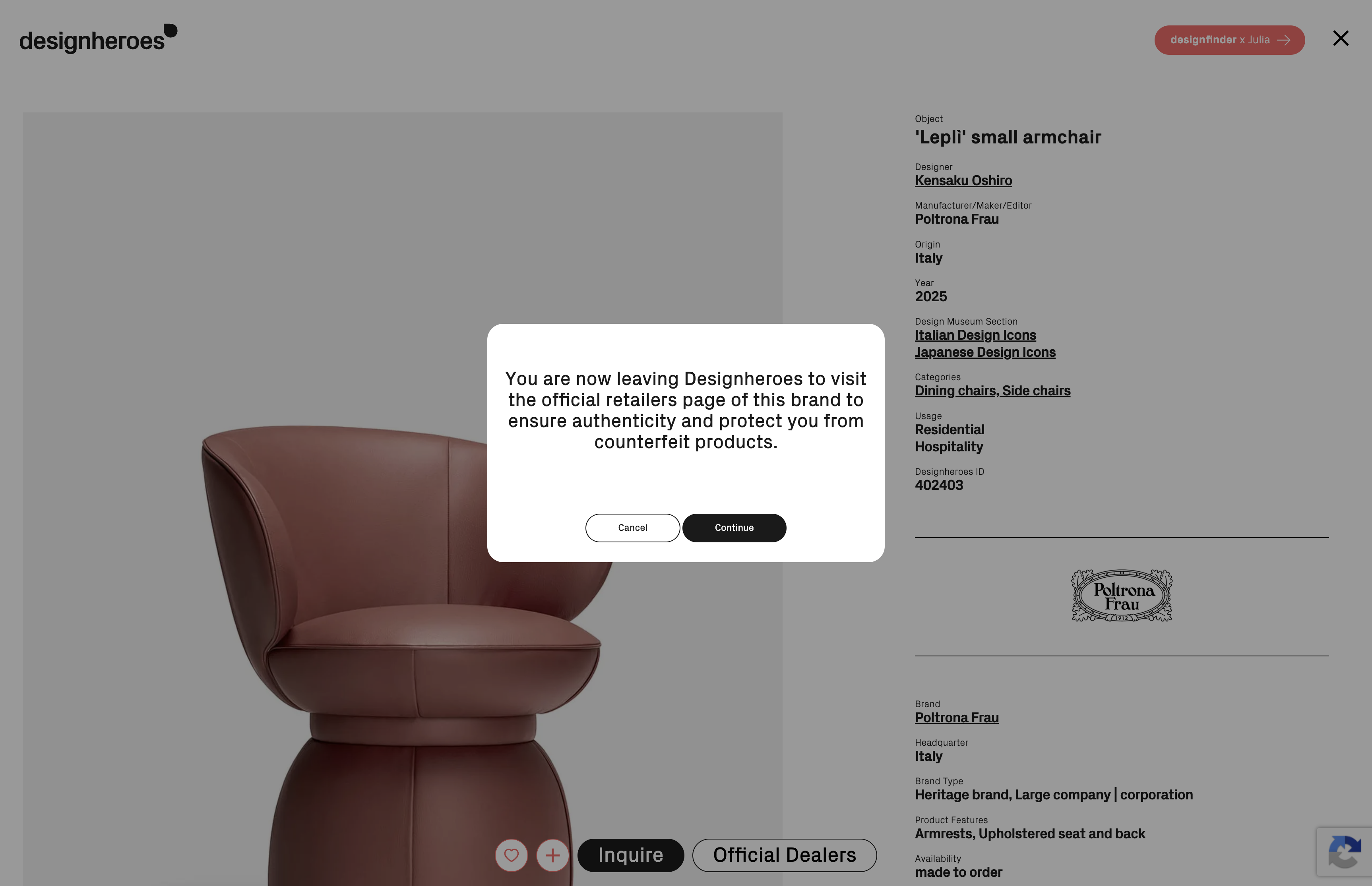
Where a new piece can be bought, we link to your own list of authorised dealers and distributors, and nowhere else. Where an older piece is trading on the secondary market, it carries its provenance. Nobody who arrives at your work here can be handed to a knock-off on the way out, and someone admiring a piece you stopped making is one click from the one that replaced it.
Nothing appears here because somebody uploaded it. Every gallery, auction house, foundation, museum and brand is reviewed by Designstandard AG before it can put a single object on the platform, and vintage pieces carry their provenance with them. Control who comes through the door and the question of what is genuine largely answers itself, which is the only way anyone can promise you no replica sits beside your original.
Six kinds of material. Your website carries one of them.
The rest of what your brand is sits in a storeroom, or in a folder nobody outside the studio has ever seen.

What you are selling now, shown in the company it deserves rather than in a price grid.

Still owned, still specified, still asked about long after the last one shipped. Most brands treat them as gone. The market does not.

What your work has done on the secondary market, tracked from galleries and auction houses and attached to your brand rather than scattered across the internet.

The work that made the brand. Evidence, not nostalgia: it is what makes the current collection credible.

The things that never had anywhere to live online. This is usually the material that makes people stop.

The material that proves the story instead of asserting it. Most of it currently exists in one binder, in one office.
A legacy only earns anything when someone uses it in a conversation. When a client asks why this piece and not the one that looks like it and costs less, conviction is not enough. Your team needs something to show.
The hardest moment in any sale is the comparison with a cheaper lookalike. Designheroes gives your people somewhere to point rather than something to say: documented history, verified originals, the designer’s own record and the market’s. One link, sent before the meeting or opened during it.
Architects, interior designers, collectors and enthusiasts, specifying for contract and for residential. They arrive already caring about provenance and reading a design history as information rather than decoration. What they are looking for is the piece with something to say: the one they can put in front of their own client, that the client connects with rather than merely approves.
Perceived value follows context. A piece shown beside recognised classics, with its origins documented, is read differently from the same piece in a search result, by a buyer and by a specifier.
A piece someone expects to keep is a different purchase from one they expect to replace. Here that expectation carries evidence: gallery and auction results are recorded against the work, so what your pieces have been worth years later is something a buyer can check rather than something you assert, and it applies across the collection rather than to one limited edition. Anything kept in use is not waste, which turns your sustainability argument from a line on your website into something a customer can check for themselves.
Most brands have a story that exists only inside the company, in the memory of people who will retire. Published properly it becomes something the whole team can use, and something that outlasts the people who remember it.
There are many ways someone meets your work, and all end at a named person on your side.
A brand page nobody visits is a brochure, and a legacy nobody encounters is a private matter. What makes this work is everywhere else your pieces turn up.
An assistant built specifically on design history — not a general model with design vocabulary bolted on — paired with a brand answer we write together with you rather than about you, so it never has to improvise who you are.
Movements and periods, designers and their careers, provenance, what a piece descends from and why it outlived the decade it was made in. A general assistant can describe a piece. One built on design history can place it, and placing it is what this audience came to ask about.
When someone asks about your brand by name, the assistant should say what you would say. As a partner we write that with you: what you make, what you stand behind, the history you want cited, the things you want known before anyone picks up a phone. Without a partnership the assistant gives only the defaults it can verify, founding year and head-office country.
Choose three. Each one gets a dedicated assistant that answers anything asked about that product: materials, dimensions, finishes, care, the designer, what it was made for and what it belongs with. A sales assistant that has read everything you hold on that product, never tires of the same question and is awake in every timezone. Its foundation is written with you, so it answers the way your best salesperson would.

We build it from your own website. One tier, everything included, and Designcatalogs Premium until the end of 2026.
We do the work, not you. You approve a draft instead of filling in a brief. And there’s no free tier — but if you’re accepted, you get all of it: the page, the placement, the protection, a named contact, and an AI layer written with you, not about you.
Your page
In context
Protection
Being reached
AI: your brand answer
AI: the product assistant
Reach
Terms
Until the end of 2026, Premium Partnership on Designcatalogs is included.
The two are sold together. You get the cultural layer here and the specification layer there: your catalogs in the library architects search when a project has to be specified, with top tier position, page level links into your own site, usage data, and the same named contact.
What that adds

Auction and gallery results are public records and we track them as they happen, for any brand whose work turns up. Everything that comes from you, your page, your archive, your brand answer, goes live only once you have approved it. If you would rather that material worked for you than merely existed, that is most of the argument for partnering.
No. Designheroes covers the design classics of today and tomorrow, not only yesterday’s. Your current collection sits alongside the archive. The point is the continuity between them.
The opposite argument is the one we would make. A brand whose older pieces are still wanted is a brand whose new pieces are worth buying. That is precisely the case your sales team struggles to make with a catalog alone.
Different moment in a design decision. Designheroes is about provenance and culture: why a piece matters. Designcatalogs is the working library architects search when a project has to be specified. You do not have to choose: until the end of 2026, Premium Partnership on Designcatalogs is included in a Designheroes partnership, because the two are sold together. Designcatalogs for brands
Who you are, who you work with, and what you have: in the archive, or in the collection you are making now. We will take it from there.
Become a brand partner